Nijsen Company is a family business in which the fourth generation is now active in the development and production of pig feed. For over 35 years, we have been combining conventional raw materials, such as grains and co- and by-products, with former foodstuffs from the food industry. We use a portion of these in our own feeds and supply these ingredients to other producers of animal feed for farm animals.
Through in-depth supply chain knowledge, technological expertise, and control over the entire process, we steer flows toward their highest value. From collection and analysis to processing, advice, and application: we make what others consider waste reusable as a high-quality raw material. In doing so, we give suppliers maximum control over their residual streams and help customers secure reliable, circular products. By doing so, we not only strengthen profitability and efficiency but also make the entire food chain smarter, more resilient, and future-proof.
We are not a traditional feed producer. We are not a waste processor. We are a director in a circular food system.
Within IPPEC, Nijsen company plays an active and connecting role. Drawing on our years of experience in valorizing residual streams from the food industry, we take the lead in raw material flows. Our goal is to gain insight into which residual streams, which are less suitable for pig feed due to their physical properties, can be optimally utilized through other animal species.
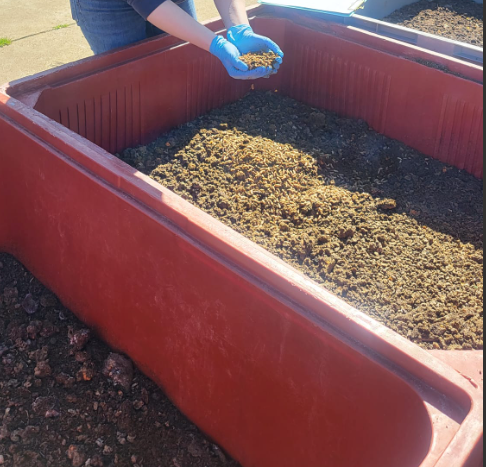
The IPPEC project is of great importance to us because it offers the opportunity to investigate and concretize these issues jointly with partners from the chain. Recent insights show that the larvae of the Black Soldier Fly (BSF) in particular are highly efficient at converting nutrients from complex residual streams into valuable products. These larvae produce energy- and protein-rich ingredients that can be reused in feed for farm animals.
In this way, we contribute to a circular food system in which nutrients are not lost, but are reused and ultimately return to the consumer’s plate, for example in the form of dairy, eggs, or meat.
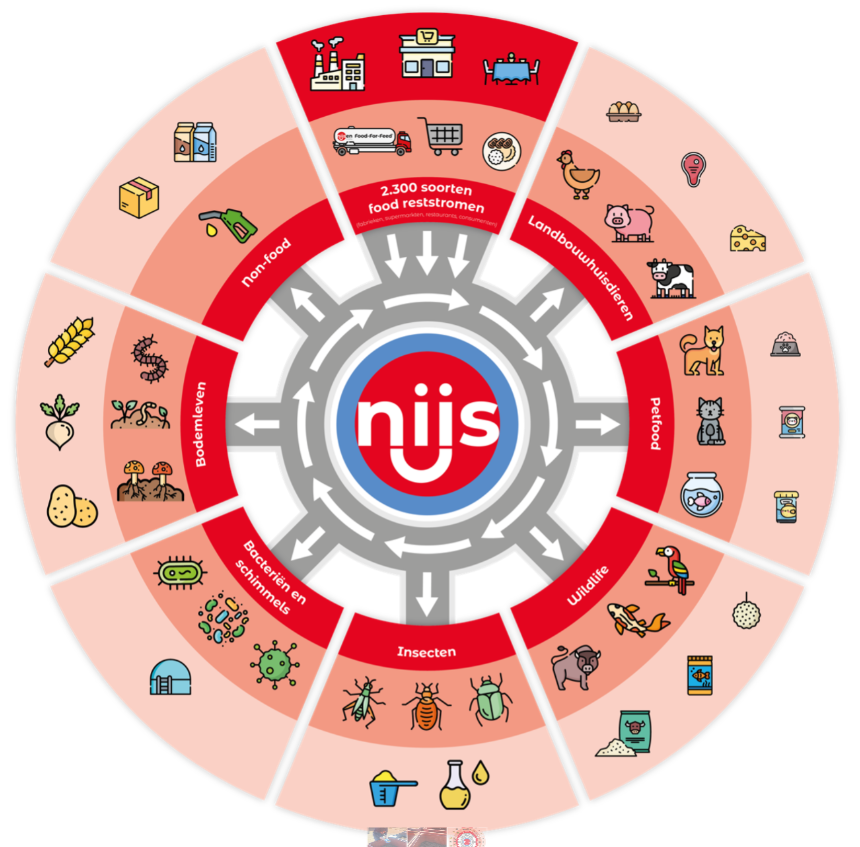
Our vision is clear: acting as a director, we aim to actively contribute to minimizing food waste. We do this by continuously analyzing which animal species allow specific residual streams to be utilized most efficiently and responsibly. In doing so, we consider not only nutritional value but also economic feasibility and scalability. We refer to this vision as the “Nijsen Roundabout”.
Together with the partners within IPPEC, we are taking an important step towards a future-proof, circular, and sustainable food system.